McCulloch v. Maryland (1819)

Background:
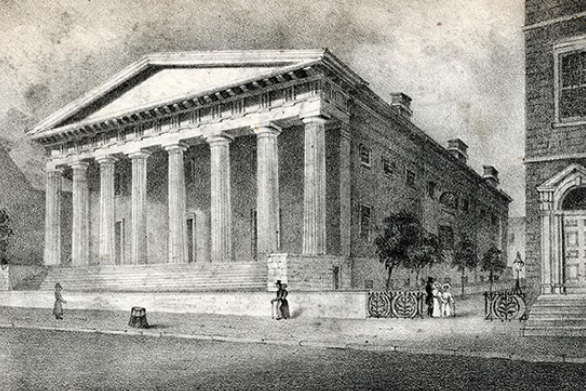
In 1816, the United States Congress created the Second Bank of the United States. Later, in 1818, the state of Maryland passed a tax on all banks not chartered directly by the state. This was intended to specifically target the Baltimore branch of the Second Bank of the United States. This act would impose a $15,000 annual tax on any bank operating in the state not chartered by the state, or the mandatory issuing and use of bank notes of a specially stamped state paper. The Second Bank of the United States was at this time the only bank in Maryland unchartered by the state. Local banks viewed this bank as an economic threat and competitor, blaming it for financial troubles during the economic depression of 1818. This tax imposed by the state of Maryland was intended to force the Baltimore branch of this bank out of the state.
The Case:
James W. McCulloch, the head cashier of the Baltimore branch of the U.S. bank, refused to pay the tax. He believed firmly that a state government did not have the authority to tax an institution created by the federal government. The state of Maryland filed a suit against McCulloch in order to collect the tax. Maryland won in state courts, leading to an appeal before the U.S. Supreme Court. This broadened the extent of the case from simply the state tax, considering whether Constitution allowed for a state to create an act taxing a private institution created by the federal government.
Debates From Each Side:
Representing McCulloch and the U.S. Bank were Daniel Webster, William Wirt, and William Pinkney. It was argued that the Necessary and Proper Clause (Article I, Section 8) allows Congress discretion to choose appropriate means to execute explicit fiscal powers. Drawing on the logic of Alexander Hamilton, it was proposed: necessary, means useful, needful, or conducive to concluding a legitimate constitutional end. Additionally, under the Supremacy Clause (Article VI), the federal government derives its authority from the American people not the individual states. This therefore implies a state government cannot tax or burden federal actions as the power to tax allows the power to destroy.
The State of Maryland was represented by Luther Martin, Joseph Hopkinson, and Walter Jones. As the defendant in error, Maryland argued the Constitution did not explicitly grant Congress the authority to create corporations. Moreover, representatives claimed that states possess the right to independent sovereignty and the absolute right to tax any property or corporation within their boundaries. Maryland contended, "necessary and proper” meant indispensable and strictly required. This implied Congress cannot choose any convenient means if the end goal can be reached another way. There was an inadvertently implied fear of federal tyranny if Congress were provided unbridled powers over state law.
Verdict:
In a 6-0 vote, the Court ruled in favor of McCulloch. At this time there were only seven Supreme Court Justices, along with Justice Thomas Todd absent on the day of this case. Chief Justice John Marshall wrote the majority opinion, ruling that Congress had the authority to establish the Second Bank of the United States under the Constitution’s "Necessary and Proper Clause”. This ruling solidified that neither Maryland, nor any other state, possessed the constitutional power to tax or burden a federal institution, or a private corporation established by the federal government.
Legacy:
This foundational landmark Supreme Court case established that Congress has implied powers under the “Necessary and Proper Clause” of the U.S. Constitution. Additionally, it held federal laws possess supremacy over state laws, meaning individual states cannot tax or interfere with federal operations. These fundamental constitutional doctrines remain important and true today. This case sparked Chief Justice John Marshall’s famous declaration, “We must never forget that it is a constitution we are expounding”, securing since the adaptable view of foundational law. This decision enabled future federal oversight, remaining relevant and important in many following cases.


Having laws that prevent states from overwriting federal laws—and vice versa—is important because it maintains national unity, prevents legal chaos, and protects individual rights. This balance of power is a core feature of federalism, a system where power is divided between a central national government and individual state governments.